


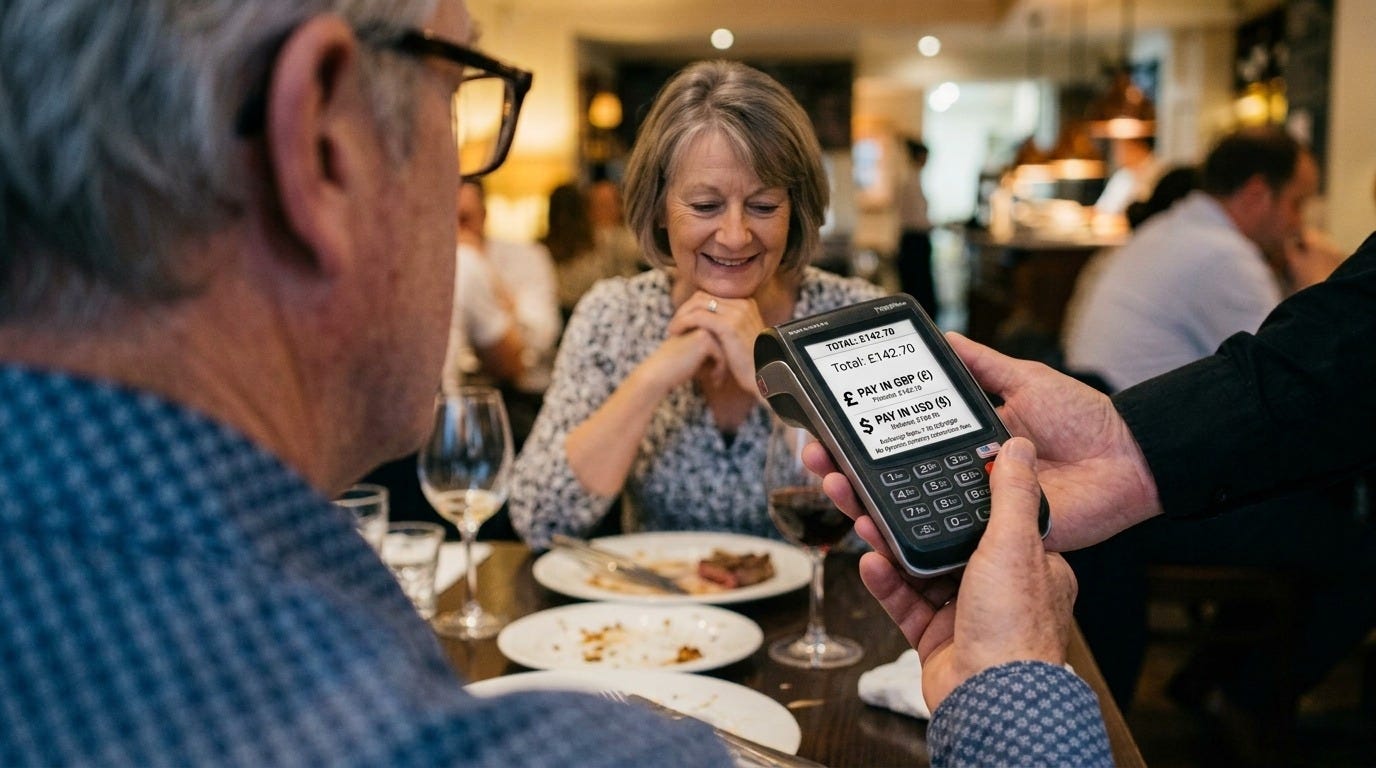
In this article we cover Dynamic Currency Conversion (DCC), a deceptively innocent name for a scheme that gives you a terrible exchange rate when paying by credit card. Here’s how this racket works and how you can avoid paying this hidden tourist tax.
The currency conversion tax
Let’s say you are from the US. You’ve just enjoyed a great meal at a restaurant in Rome. The waiter brings the credit card machine to the table, runs the card, then hands the machine to you to approve the amount.
You have to make a split second decision: pay in US Dollars or Euros. You are from the US! You like knowing exactly how much is being charged to your card! Why wouldn’t you want to pay in US dollars???
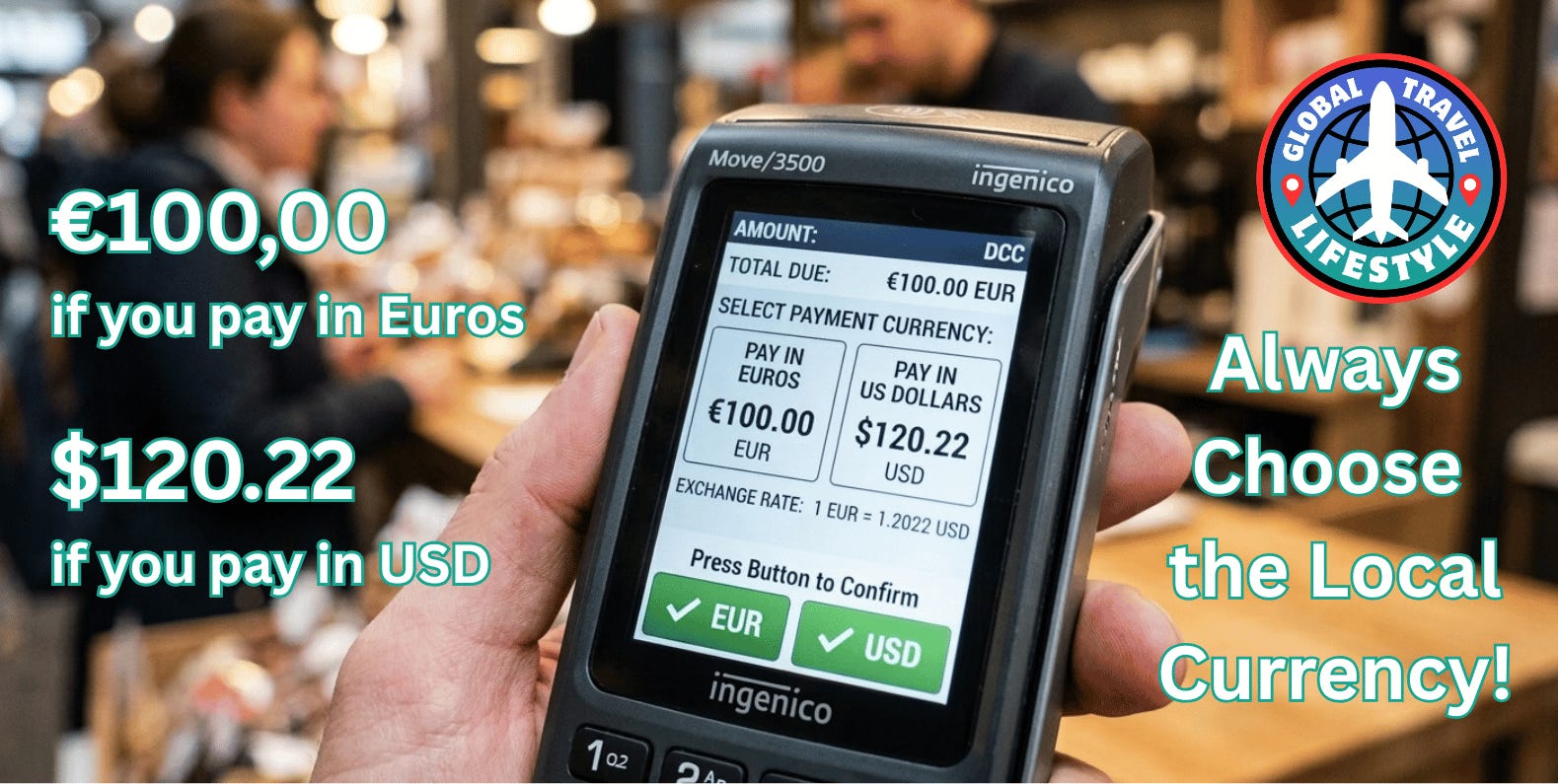
The split second decision that costs you
You’re not a walking calculator. In the split second you have to decide, $120.22 seems about right. But herein lies the deception.
You are unlikely to be informed that the conversion rate will be much better if you select the local currency instead (Euros in this example). Doing so would have lowered the cost of your meal to US$114.50. If you had selected USD, you would have needlessly paid 5% more for dinner!
This is Dynamic Currency Conversion in action and according to VISA it usually adds 3% to 7% or more to your cost through inflated exchange rates. This may not seem like a big deal for one dinner but if you make it a habit you are literally throwing away hard earned money for nothing in return.
PRO TIP: If traveling outside your home currency market, use a credit card that has no foreign transaction fees. These fees often add another 1-3% on top of any DCC fees you might also pay!
Conversion anxiety? There’s a fix for that
If you have anxiety about doing quick currency conversions in your head, my advice is to turn on international transaction alerts with your credit card. I often use my Capital One Venture card when traveling (because they do not charge foreign transaction fees) and they allow me to turn on email and/or text alerts. Every time I charge something internationally, I instantly get a text from Capital One with the amount converted into USD. Chase offers similar alerts, although you can only get them for all transactions over a certain amount you specify.

Why isn’t DCC more transparent?
Because the restaurant is in on the deal - they get a sizable chunk of the profits in the form of a monthly kickback.
Many moons ago, the restaurant’s credit card payment processor approached the owner with a win-win pitch: Would you like to offer your customers the “convenient choice” to pay in their home currency or Euros? It will only cost the customers a small additional fee.
DCC is common in tourist areas but not all merchants buy in on the pitch. Many take a long view and know this is just another way to inflate costs and channel even more money to financial institutions beyond the normal credit card processing fees they already pay. Thus, you are more likely to see DCC deployed by gift shops, coffee shops, restaurants, hotels, and tour operators in touristy areas.
As much as you would like to cast blame on VISA or MasterCard, they are not the key players in this scheme. Third-party DCC providers - most of whom you have never heard of - are the ones who offer this “product.”
GOOD TO KNOW: DCC is also used widely in ATM machines, especially at airports or in touristy areas. Again, always choose the local currency when withdrawing money.
How do I know I am being overcharged?
If you are concerned about a merchant overcharging you by taking advantage of your exchange rate confusion, I’ve been traveling internationally for 30 years and cannot think of a single situation where a merchant tried to pull a fast one on me in a credit card transaction. (At least that I know of) That’s not to say it doesn’t happen but it’s FAR more likely to happen when CASH is used to pay. I have definitely been screwed many times when paying cash, especially in markets.
The moral of this story is, always always always pay in the local currency. This will get you the wholesale conversion rate offered through VISA and MasterCard instead of the much worse “dynamic” currency conversion rate.
About Chris
In 2026, after 25 years in Austin, Chris and Julie sold most of their possessions and decided to travel globally full time. Chris started focusing on travel writing after a long career as a copywriter and marketing executive. A lifelong learner, he focuses on what it takes to plan, sustain and love life as a long-term traveler, and associated practicalities for people over 50. Although new to travel writing, he is certainly not new to travel, with 100+ border crossings on 6 continents since 1997.

Good advice. Of all the places where I haven’t seen this deployed in tourist areas is Vietnam. I’ve also found that they tell me the price and then show it to me on the machine without any prompting on my part.
Definitely agree though that ATMs are one of the worst culprits.
It's always good to be reminded of this. Getting money from an ATM or paying a bill are often stressful events when you're brand new to a country, especially if the whole transaction is in a language that you don't speak or read.