


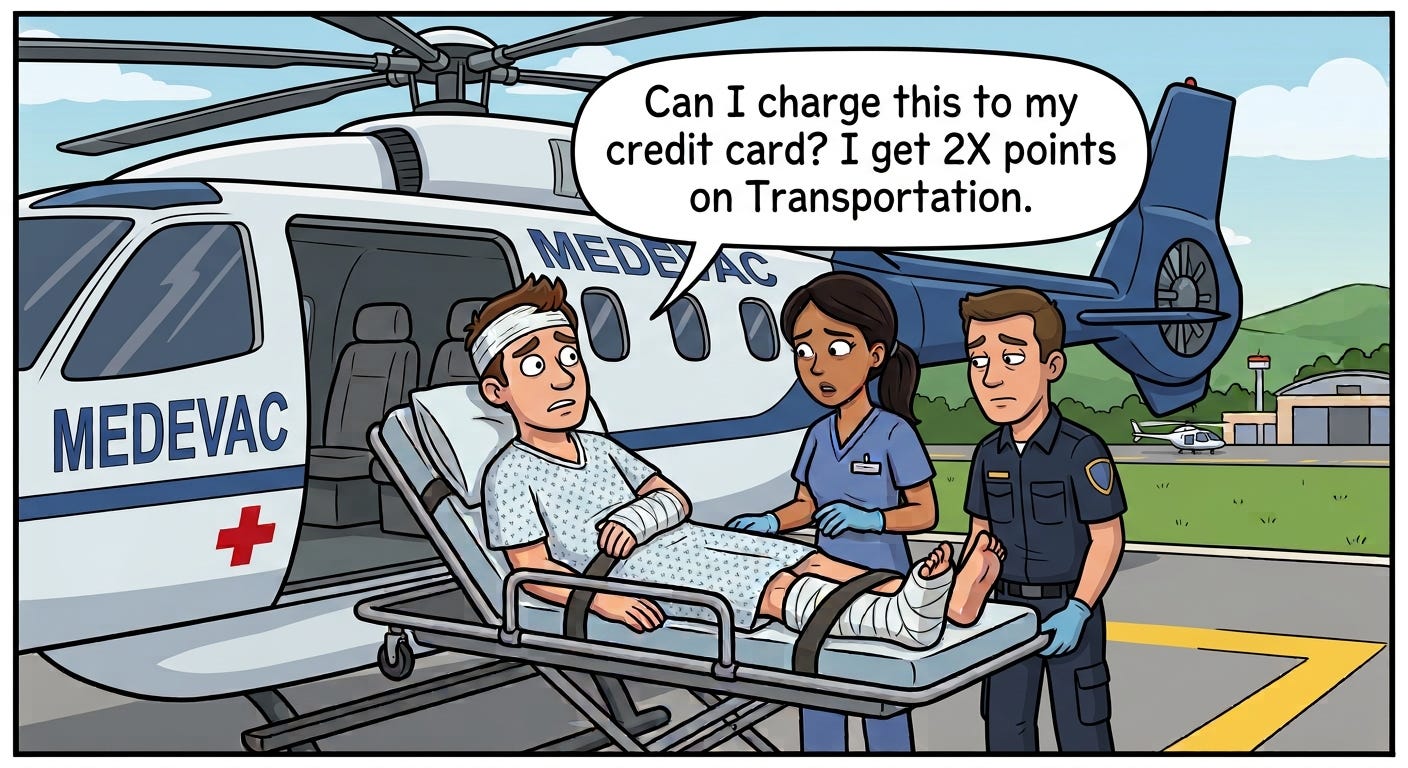
NOTE: I’m NOT an insurance agent but I am a frequent world traveler who feels less anxious when prepared. This article is about international medical evacuation costs (not inside the US). I did intensive research on this topic to satisfy my own curiosity and needs and I’m sharing my research because perhaps you may find it useful too. Be sure to look over the list of 20 providers toward the end of the article. Consult a licensed insurance agent before making any decisions on coverage as policies vary widely by company.
A shift in risk tolerance that comes with age
Over the last 20 years, my wife and I have traveled to remote areas of Brazil, Kenya, Turkey, Chile and the USA. Honestly, I never thought twice about what would happen if one of us were to get badly injured or become seriously ill. Now, in my 50s with a nest egg to protect, I have found that my air of invincibility and tolerance for financial risk seem to recede in lockstep with my hairline.
My wife and I are in our late 50s and have no serious ongoing health issues…at the moment. Nonetheless, we are transitioning from our “settled” life in Austin to a lifestyle as full time nomads, and that got me thinking about potential “hit by a bus” medical situations.

Why now?
In recent years we have seen many friends and family deal with sudden and serious health issues, at home and while traveling. Handling an emergency medical situation is difficult enough where you have established medical providers nearby but imagine dealing with the aftermath of something really serious in an unfamiliar locale, in another language and without the backup of friends or family. Yikes.
What if I break my leg while trying to artfully film a flamingo in the Atacama Desert?
What if I face-plant after slipping on wet steps at Machu Picchu and mess up my shoulder and neck?
What if I keel over from a heart attack after decimating the shrimp buffet for the 10th day in a row on a transatlantic cruise?
The scary high cost of medical evacuations
You’ve read this far so no doubt heard horror stories of poor souls that needed to be airlifted out of a ravine, or transported from a remote island…at a cost of $100,000, $200,000 or more! For obvious reasons, social media and insurance companies amplify these true stories. But it begs he question: Should you buy coverage for the rare chance that you will be injured enough to require a $250,000+ flight? In short, yes.
In a 2025 article with Forbes, a spokesperson from Allianz Global Assistance quoted the following prices for an air ambulance flight back to the US:
From the Caribbean or Mexico: $15,000 - $25,000**
From Europe: $65,000 to $90,000**
From Asia, Australia and Middle East: $165,000 to $225,000**
In a 2023 interview with a CBS affiliate in Pittsburgh, Clif Carothers, CEO of Air Ambulance quoted the following prices for an air ambulance flight back to the US:
From Europe: $80,000 to $100,000*
From Africa: $130,000*
From Asia: $200,000*
Keep in mind that the averages cited above are across ALL medical evacuation claims handled by these companies. Sometimes an “evacuation” consists of transport via local ambulance followed by a commercial first class ticket home after someone has been medically stabilized. Sometimes - and these are often the examples used by insurers - it’s a private jet or helicopter equipped with advanced medical capabilities and a small team that may include a paramedic, nurse and/or doctor. So, yes, the cost CAN exceed the numbers noted above!
To get some further context, I reviewed hundreds of comments in travel-related Facebook Groups from those who actually used (or knew someone who needed) international emergency medical evacuation. Many examples were in line with those noted above but sometimes higher.
GOOD TO KNOW: At least one insurer specifically excludes coverage if you engage in alligator wrestling, bull riding, base jumping, train surfing or (my favorite) wing suit flying. Avoid those activities. ;-)
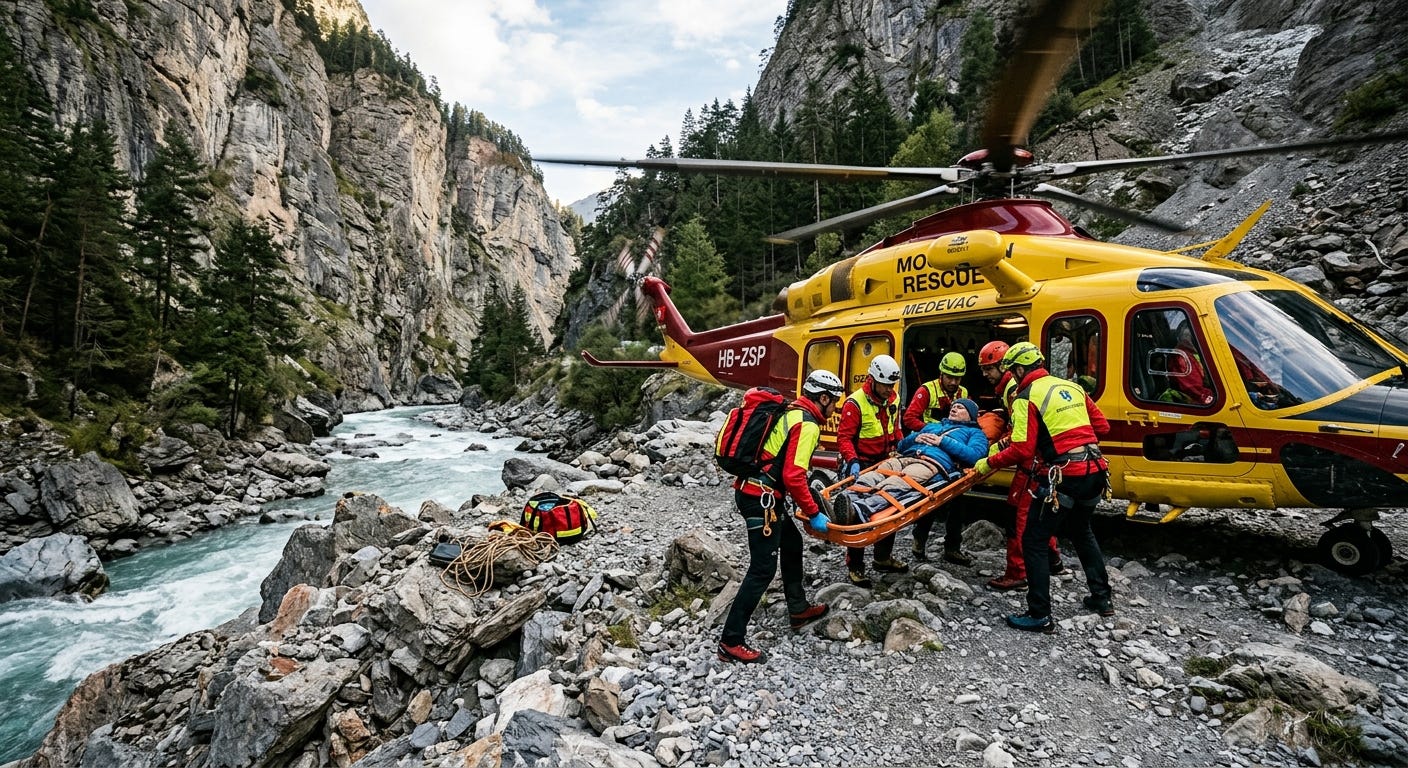
Why does emergency medical evacuation cost so much??
The cost of medevac services can be shocking and many people wonder why it is so expensive. There are many factors that impact the cost of medical evacuation by air, most of which do not apply to ground/water transport:
Aircraft base fee (before it even takes off)
Aircraft per mile/km charges
Aircraft fuel
Aircraft flight permits, landing fees and logistics
Advanced medical equipment on aircraft
Distance it must travel empty from its base
Distance it must travel to hospital/airport after pickup
Aircraft pilots/ground crew
In-flight nurses/paramedics/doctor
Staffing for 24/7/365 on-call availability
REMEMBER: Most medical evacuation policies are designed to get you to the nearest qualified medical facility where you can be treated. This does not mean they’re going to fly you back to your home country. Some companies do offer this benefit. Read the fine print carefully if this matters to you.
Sequence of events in a typical scenario
Let’s say you break numerous bones in a scooter accident on an island in southern Thailand. You are in bad shape.
Local emergency services take you via ambulance to the nearest hospital or medical facility on the island for initial treatment and stabilization. The initial emergency transportation is normally covered under your emergency travel medical coverage.
At this point it is ESSENTIAL to contact your medical/medevac insurance provider. The local doctor will then work with the insurers medical team and determine whether you need to be transported to a hospital in Bangkok via medevac helicopter or airplane. The doctor and insurer’s medical team will make this determination (not you). Your medical evacuation insurer will pay the medevac provider directly!
Once at the Bangkok hospital, the local attending doctor will assess your condition and continue treatment. Unless your specific insurance allows you to request transfer (or it’s medically necessary) to a hospital in your home country, Bangkok is where you will receive most/all treatment until you are well enough to fly home on a commercial airline.
PRO TRAVELER TIP: Your mobile phone has an emergency SOS trigger built in. Understand how it works. Also, remember 112. Similar to 911 in the US, it will connect you with emergency services in Europe, UK, India, Australia, New Zealand and other countries.
Risk factors that influence how much coverage you should get
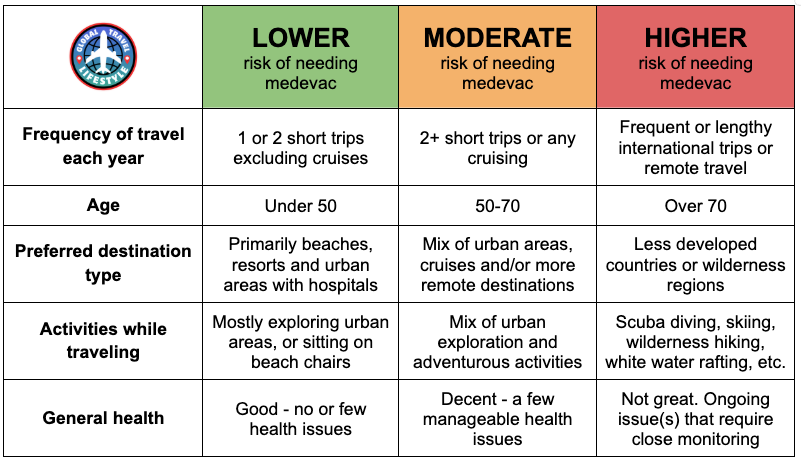
Most travel insurance policies or standalone medevac membership plans provide anywhere from $100,000 to $1,000,000 in coverage. Although the cost of these policies is not huge, the financial impact of a medical emergency surely can be. If you look at the table below and are solidly in the green low risk category, you might feel comfortable with less coverage. If you are in the moderate or high risk category for any of the factors below, higher limits may be right for you. Ultimately, insurance is a game of odds based on the factors below and it comes down to how much you want to pay for peace of mind.
GOOD TO KNOW: If you are not in great health and have some serious ongoing issues, you may not be covered for incidents related to that condition. Read your policy very carefully.
Two additional factors that play a role
Would a $200,000 medical emergency bill ruin you financially? If you do not have liquid assets or credit lines to come up with a six figure amount of money very quickly, definitely make sure you get adequate coverage.
Are you generally anxious about medevac costs? If you are someone like me that generally likes to be prepared (after all, who would write an article like this???) and it reduces the stress associated with travel, go big.
GOOD TO KNOW: Travel medical insurance (care) is different from emergency medical evacuation (transportation) coverage. Many travel medical policies include medevac coverage but not all medevac plans include coverage for medical care. Make sure you have both!
Companies that provide medevac coverage and maximum limits for transport and care
The following companies are popular among those who frequently travel internationally. This list is NOT an endorsement (list is in alpha order) and we do NOT receive any compensation from any of them. Most limits in USD.
Allianz
Emergency EVACUATION: Up to $1,000,000
Emergency CARE: Up to $75,000
AXA
Emergency EVACUATION: $1,000,000
Emergency CARE: Up to $250,000
BCBS Global Solutions
Emergency EVACUATION: $500,000
Emergency CARE: Up to $1,000,000
BHTP (Berkshire Hathaway)
Emergency EVACUATION: Up to $750,000
Emergency CARE: Up to $75,000
Emergency Assistance Plus (EA+)
Emergency EVACUATION: Unlimited
Emergency CARE: Not offered
Faye
Emergency EVACUATION: $500,000
Emergency CARE: $250,000
Freely
Emergency EVACUATION: $1,000,000
Emergency CARE: $500,000
Gallagher | Heymondo
Emergency EVACUATION: Up to $500,000
Emergency CARE: Up to $200,000
Generali
Emergency EVACUATION: Up to $1,000,000
Emergency CARE: $250,000
Genki
Emergency EVACUATION: €1,000,000
Emergency CARE: €1,000,000
IMG Global Rescue
Emergency EVACUATION: Up to $8,000,000
Emergency CARE: Up to $8,000,000
International SOS
Emergency EVACUATION: $1,000,000
Emergency CARE: $50,000
Medjet
Emergency EVACUATION: $1,000,000
Emergency CARE: $75,000
Mondial
Emergency EVACUATION: Unlimited
Emergency CARE: Not offered
Safety Wing
Emergency EVACUATION: $100,000
Emergency CARE: Up to$1,500,000
Seven Corners
Emergency EVACUATION: Up to $500,000
Emergency CARE: Up to $1,000,000
Tin Leg
Emergency EVACUATION: Up to $1,000,000
Emergency CARE: Up to $500,000
Travelex
Emergency EVACUATION: Up to $1,000,000
Emergency CARE: Up to $250,000
Travel Guard
Emergency EVACUATION: Up to $1,000,000
Emergency CARE: $50,000
Trawick International
Emergency EVACUATION: Up to $1,000,000
Emergency CARE: Up to $1,000,000
In addition, aggregators like Squaremouth and InsureMyTrip, allow you to compare multiple companies simultaneously. Did we make a mistake? Leave a comment so we can fix it.
NOTE: Some of these companies combined have a combined maximum for all claims. Many also have maximum trip length requirements. Read the fine print before purchasing.
GOOD TO KNOW: The insurance you have at home may provide basic emergency medical coverage abroad, but is very unlikely to provide medical evacuation coverage outside your home country.
No, you probably can’t get reimbursed or pay later
Okay if this fact alone doesn’t make you want to get some medical evacuation coverage I’m not sure what will: Unlike traditional medical insurance, medevac services are usually “pay at time of service.” That means if you are unlucky enough to need medical evacuation, and even more unlucky to lack insurance coverage, you’ll need to cough up a lot of money on the spot. That’s true for medical treatment as well! And to address what you might be thinking: no they are not going to accept your promise to wire the money after you get home.
Keep in mind that even if you maintain health insurance in your home country it often does not extend beyond your borders. For this reason, it is absolutely essential that you get insurance and DO NOT try to arrange emergency transport yourself. You must contact your insurer who will determine whether medical evacuation is necessary, and coordinate everything including where you will go. They will also pay the medevac provider directly.
Your credit card probably does not provide enough (any) coverage
Many travel credit cards tout their coverage for trip delay, lost luggage, rental car coverage and even travel accident insurance. But details matter. Read the fine print and you’ll see that very few offer medical evacuation coverage. A few exceptions: the Chase Sapphire Preferred and Reserve cards offer up to $100,000 in medevac coverage…IF you used the card to pay for your trip. The American Express Platinum card also provides coverage and has no upper limit, but the card is expensive. Even if you have one or both of these cards, I’d be nervous about relying on them as my only source of medevac coverage.
PRO TRAVELER TIP: Always carry a physical card with your insurance contact information. You or your travel partner may be too shocked to look up who to contact in an emergency.
$500,000 works for us
How much coverage should you get? There is no right answer. If you are in the low risk category noted earlier and carry a Chase Sapphire or Amex Platinum card, you might be perfectly comfortable with $250,000. We travel internationally a lot but are still in good health so I am comfortable with a policy that has a cap of $500,000. It’s really a matter of your personal health profile, where and how you travel, and your tolerance for risk. In the end, these policies are not expensive so getting higher limits is not going to break the bank. Buy it!
Thanks for reading!
Researching and writing this article (no AI writing here!) took me 20+ hours. If you derived some value from it, please “heart” it as this will help make it available to more people like you on Substack. Thank you!
About Chris
In 2026, after 25 years in Austin, Chris and Julie sold most of their possessions and decided to travel globally full time. Chris started focusing on travel writing after retiring from a long career as a technical writer and marketing executive. He specifically focuses on what it takes to plan, sustain and love life as a long-term traveler, and associated practicalities for people over 50. Although new to travel writing, he is certainly not new to travel, with 100+ border crossings on 6 continents since 1997. Chris has won no writing awards, has no fancy bylines to tout, but is pretty good at sharing insights that inspire and inform. Come along for the ride!
For seniors with Medicare A and B and Medigap, you need the travel insurance policy! Some Medigap policies do have an add-on for partial coverage when out of the US.
My mother had a serious injury on a top-end, small-boat cruise, in the middle of one of the more remote parts of the planet. The shipping company dumped her off on a tiny island. Getting her out of there cost many tens of thousands of $$$, and that was around 25 years ago. She and her husband had travel insurance, but much of the cost was out-of-pocket and had to be approved for reimbursement, well after the incident.